All projects
Personal · Persistent MMO
Reactor 48
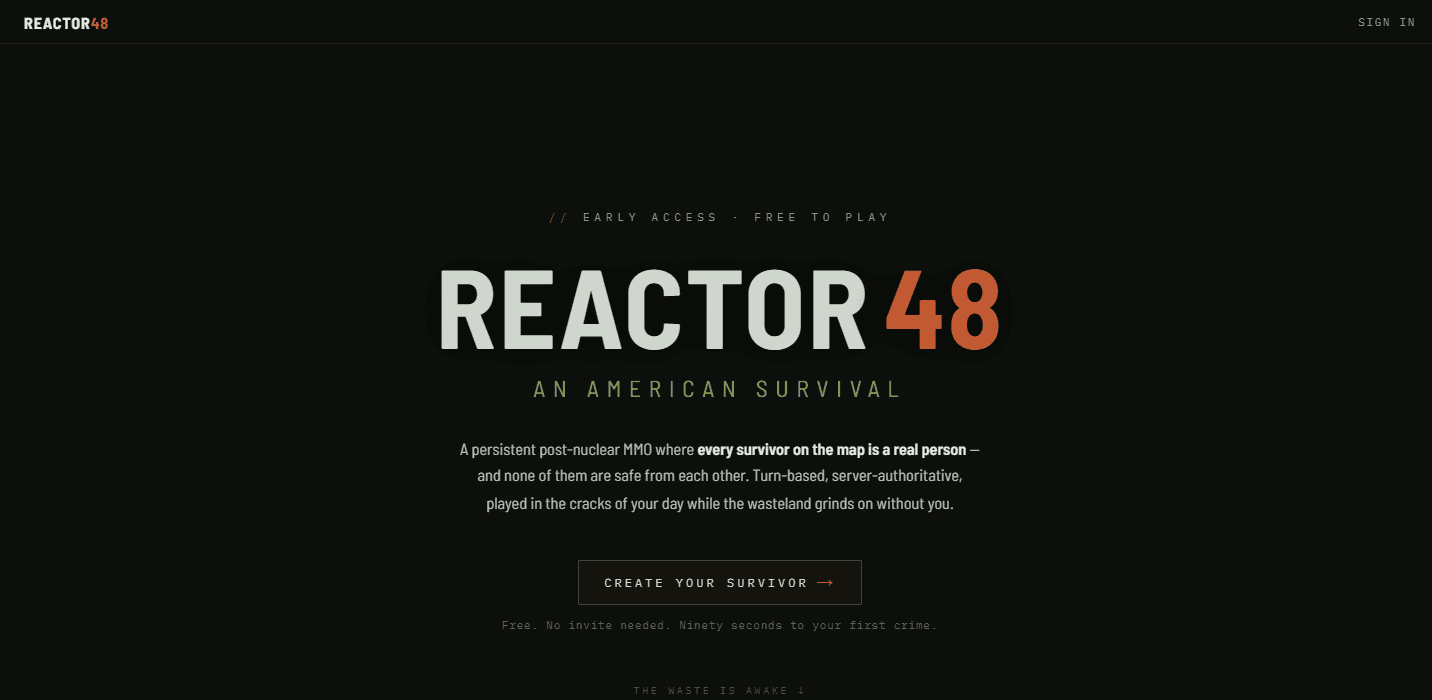
A persistent post-nuclear MMO where every survivor on the map is a real person — and none of them are safe from each other.
Visit reactor48.com Early Access · Solo Founder
What it is
A world that keeps turning after you close the tab.
Reactor 48 is a turn-based, persistent post-nuclear MMO played entirely in the browser. There are no NPCs to farm and no scripted encounters — every survivor on the map is another player, the entire economy is goods they scavenged and priced themselves, and the wars are fought between factions of real people over days at a time.
The design is built around a single constraint: the world is server-paced, so it moves whether or not you’re logged in. That makes it playable in ten minutes a day, and it makes every absence cost something. No seasonal resets, no wipes, no wallet that buys power — one continuous world where the strongest survivor on the map earned it.
6 systems · 1 world
What you’re walking into
Every survivor is real
Open PvP
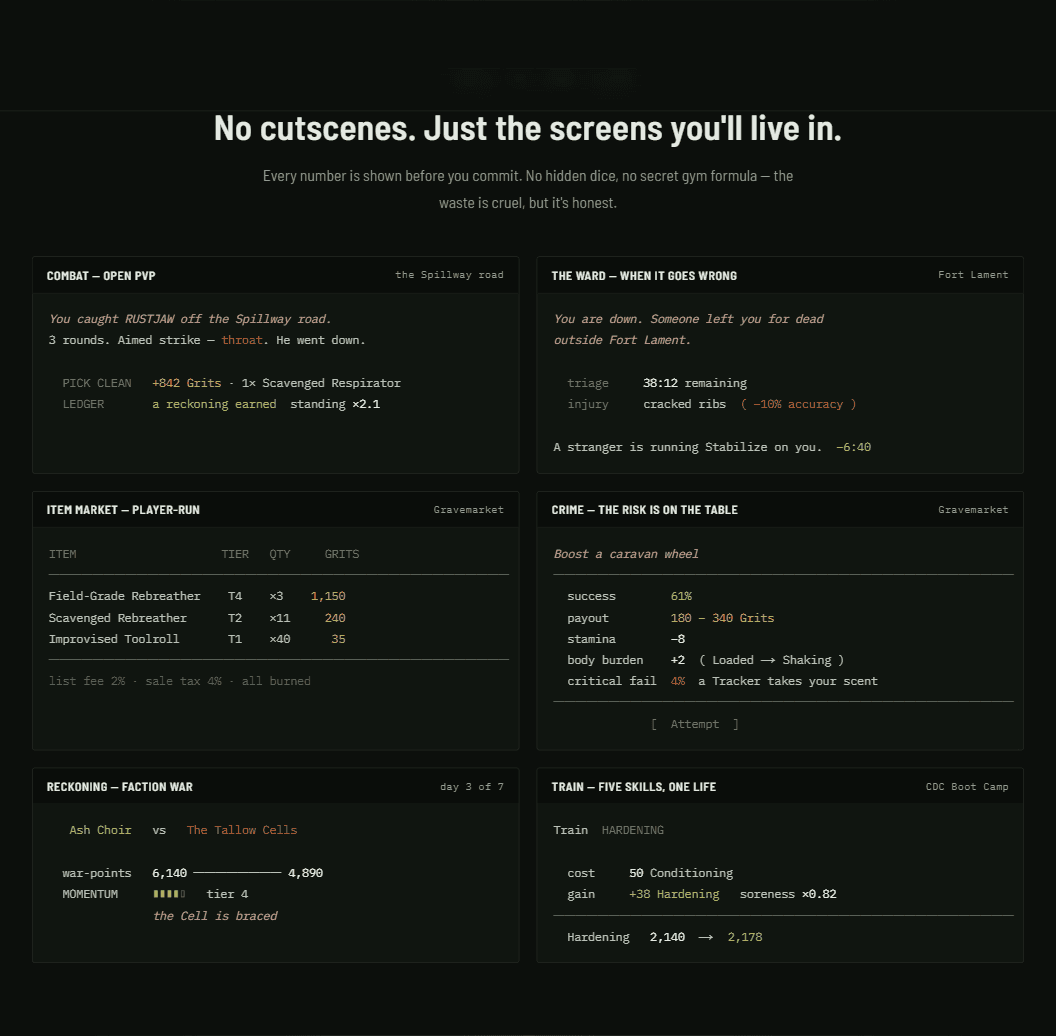
No NPCs to farm. Knock someone down and you choose what happens next — walk away, or pick them clean. Turn-based combat where every probability is shown before you commit: no hidden dice, no secret formula.
When it goes wrong
The Ward
Going down isn't a respawn. You're left for dead with a triage timer counting and an injury that follows you — cracked ribs at −10% accuracy until someone patches you up. A stranger running Stabilize on you is a real player choosing to.
No vendor prices
Player-run market
Every rebreather and round of ammo was scavenged, crafted, or looted by another player — and priced by them. Haul goods across the Rads between regions and eat the spread. List fees and sale tax burn out of circulation.
Risk on the table
Crime
Every job shows success odds, payout range, stamina cost, body burden, and critical-fail chance before you attempt it. Blow the roll badly enough and a Tracker takes your scent.
Faction war
Reckoning
Bind into a Faction, drill in its Cell, and put its name on the map. Multi-day wars tracked on war-points and momentum tiers — territory, rackets, and reckoning on a ledger everyone can see.
Permanent consequences
Five skills, one life
Muscle, Hardening, Reflex, Fieldcraft, Wits — one survivor, no wasted stats and no respec. Training costs Conditioning and accrues soreness. Ten regions to cross, and every road wants you dead.
Design
Four decisions the whole game hangs on
01 Persistence over sessions
The world is server-paced, not session-paced. Stamina regenerates, crimes cool down, caravans arrive, and rival players move while you're logged off. That single decision reframes the whole design — it makes a ten-minute daily play session viable, and it means the cost of ignoring the world for a week is real. There are no seasonal resets and no wipes: one continuous world, and the consequences carry.
02 Honest numbers
Every action shows its odds before you commit — success percentage, payout range, stamina cost, body burden, and the critical-failure chance that puts a Tracker on your scent. Nothing is resolved client-side. The design bet is that transparency creates more tension than mystery does: when players can see exactly what they're risking, choosing to risk it means something.
03 An economy with no faucet
There are no vendor prices and no fixed loot tables. Every item in circulation was scavenged, crafted, or looted by a player, and priced by one. List fees and sale tax burn currency back out of the supply, so inflation has a counter-pressure. Moving goods between regions is a real arbitrage play — and the corridor between them is where other players are waiting.
04 Consequences that persist
Getting knocked down isn't a respawn. You land in The Ward with a triage timer running and an injury that follows you out — cracked ribs at −10% accuracy until someone stabilizes you. Five skills with no respec means every training decision is permanent. The result is a world where players carry visible history, and where helping a stranger off the floor is a genuine choice rather than a scripted event.
Solo build
What I built
- Designed and built a persistent server-paced world — stamina regens, crimes cool, caravans arrive, and enemies move whether or not you're logged in; no seasonal resets, no wipes, one continuous world
- Server-authoritative to the last click, with every probability surfaced before the player commits — success odds, payout range, stamina cost, body burden, and critical-fail chance all shown up front
- Built a fully player-run economy with no vendor prices and no fixed loot — every item in circulation was scavenged, crafted, or looted by a player and priced by one, with list fees and sale tax burning currency out of the supply
- Implemented open-world PvP with real consequences — downed players enter The Ward with a triage timer and persistent injuries (cracked ribs at −10% accuracy) that other players can choose to stabilize
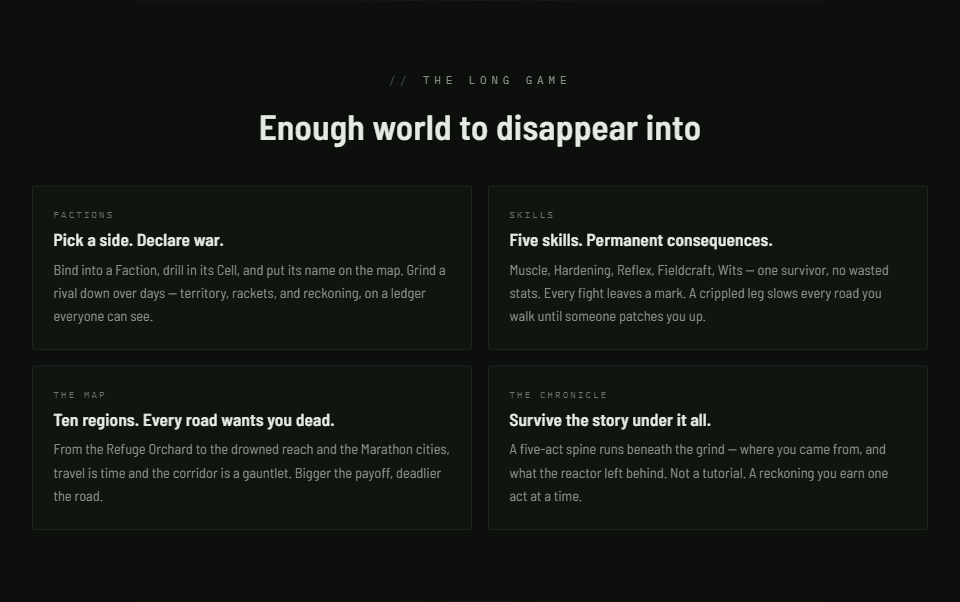
- Shipped a five-skill progression system (Muscle, Hardening, Reflex, Fieldcraft, Wits) with no respec — permanent consequences by design, where a crippled leg slows every road you walk until someone patches you up
- Built multi-day faction warfare — Reckonings tracked on war-points and momentum tiers across territory, rackets, and a public ledger every player can audit
- Ten interconnected regions where travel is time and risk — bigger payoffs sit behind deadlier corridors, making route choice a core economic decision
- Wrote a five-act narrative spine that runs beneath the systems — earned progressively through play rather than delivered as a tutorial or cutscene
- Committed to a strict no-pay-to-win economy — premium currency buys time and comfort, never power, never caps, never a single skill point
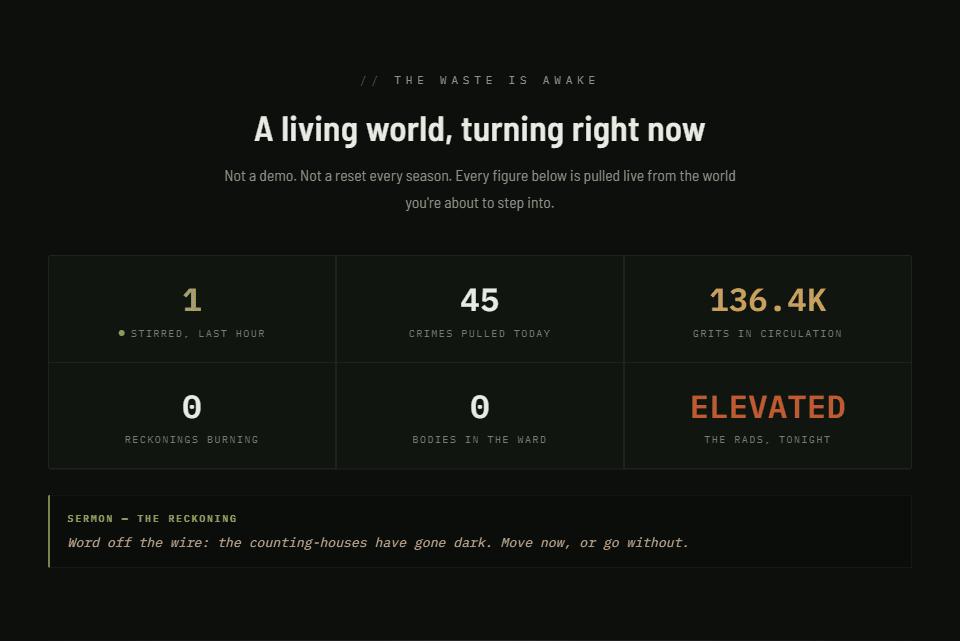
- Live world telemetry surfaced on the marketing site — survivors stirred, crimes pulled, currency in circulation, and active Reckonings all pulled from the running game world
Stack
Tech
MMOGame DesignPersistent WorldPvPPlayer EconomyTurn-BasedServer-AuthoritativeWebFounder